

Commercial dishwashers help restaurants, hotels, and commercial kitchens process large volumes of tableware more quickly and consistently. However, dishwasher performance depends not only on the equipment but also on using the right chemicals at the appropriate dosage in each wash cycle.
When chemicals are dosed manually, the amount used may vary between employees or work shifts. Using too much leads to waste, while using too little may affect washing results and result in the need for rewashing.
This is why an automatic chemical dosing system for commercial dishwashers is used to provide more consistent control over chemical usage.
What Is an Automatic Chemical Dosing System?
An automatic dosing system is connected to the dishwasher to dispense chemicals into the system according to predefined settings. When the machine operates, chemical dosing takes place automatically instead of requiring staff to measure and add chemicals manually.
For commercial dishwashers, the system typically works with two chemical groups: detergent and rinse aid.
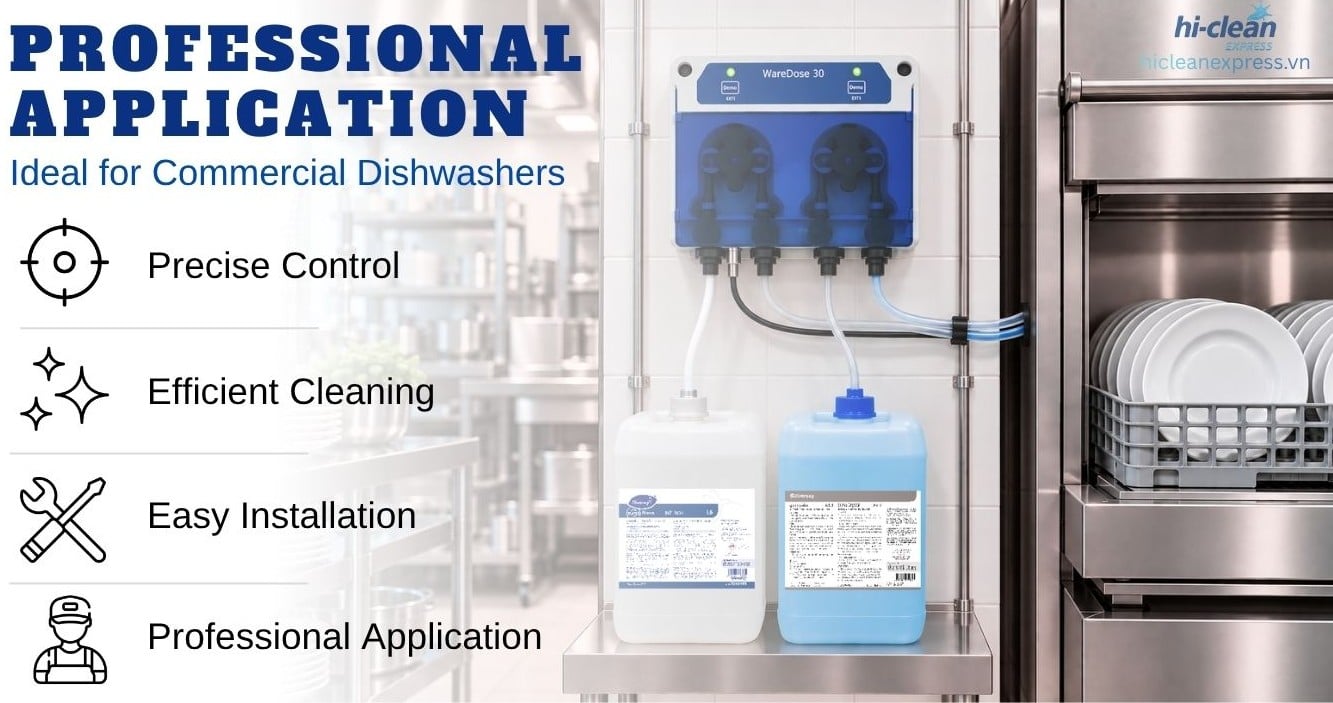
These two chemicals perform different functions and are dispensed into the dishwashing process according to the appropriate settings. To learn more about the role of each chemical, see our guide to commercial dishwasher chemicals.
Why Can Manual Chemical Dosing Increase Costs?
The main issue with manual dosing is variation between each use. Different employees may use different amounts of chemical, while the tendency to “add a little more for better cleaning” can also result in more chemical being used than necessary.
When a dishwasher operates frequently, even a small amount of excess chemical in each cycle can accumulate into significant consumption over time. Conversely, insufficient dosing may affect washing results and lead to rewashing.
The goal, therefore, is not to use as little chemical as possible, but to use the appropriate amount and maintain that level consistently.
Benefits of Chemical Dosing Systems for Commercial Dishwashers
Using a chemical dosing system for commercial dishwashers helps businesses control chemical usage, maintain more consistent dosing between wash cycles, and reduce manual dosing tasks. These are important considerations when dishwashers are operated regularly in restaurants, hotels, and commercial kitchens.
Control Chemical Usage and Reduce Waste
The system dispenses chemicals according to predefined settings instead of relying on employees to estimate the required amount. This helps reduce over- or under-dosing and gives businesses better control over chemical consumption.
For dishwashers running many cycles, even a small difference in the amount dispensed per cycle can become significant when calculated across total monthly or annual usage.
Maintain Consistent Operation Across Work Shifts
A dosing system helps reduce differences in chemical usage between employees and work shifts. Once the dosage has been appropriately set, the amount of chemical introduced into the washing process becomes more consistent and less dependent on employees manually measuring, estimating, or adding chemicals.
Maintaining consistent chemical usage also makes it easier for businesses to standardize commercial dishwasher operating procedures.
Simplify the Chemical Dosing Process
Instead of requiring employees to manually measure and add chemicals, the system handles chemical dosing during dishwasher operation. This reduces direct chemical-handling steps and simplifies routine tasks for employees operating the machine.
For systems using both detergent and rinse aid, suitable dosing equipment also helps manage the delivery of each chemical according to its function in the wash process.
Reduce Additional Costs Associated With Inconsistent Washing Results
Chemical dosage is one of the factors that can affect washing results. If the amount of chemical is inappropriate and tableware needs to be rewashed, the business incurs additional chemical, labor, and machine operating costs.
More consistent dosing helps reduce one of the potential causes of rewashing.
Three key benefits of chemical dilution and dosing systems in professional cleaning operations:
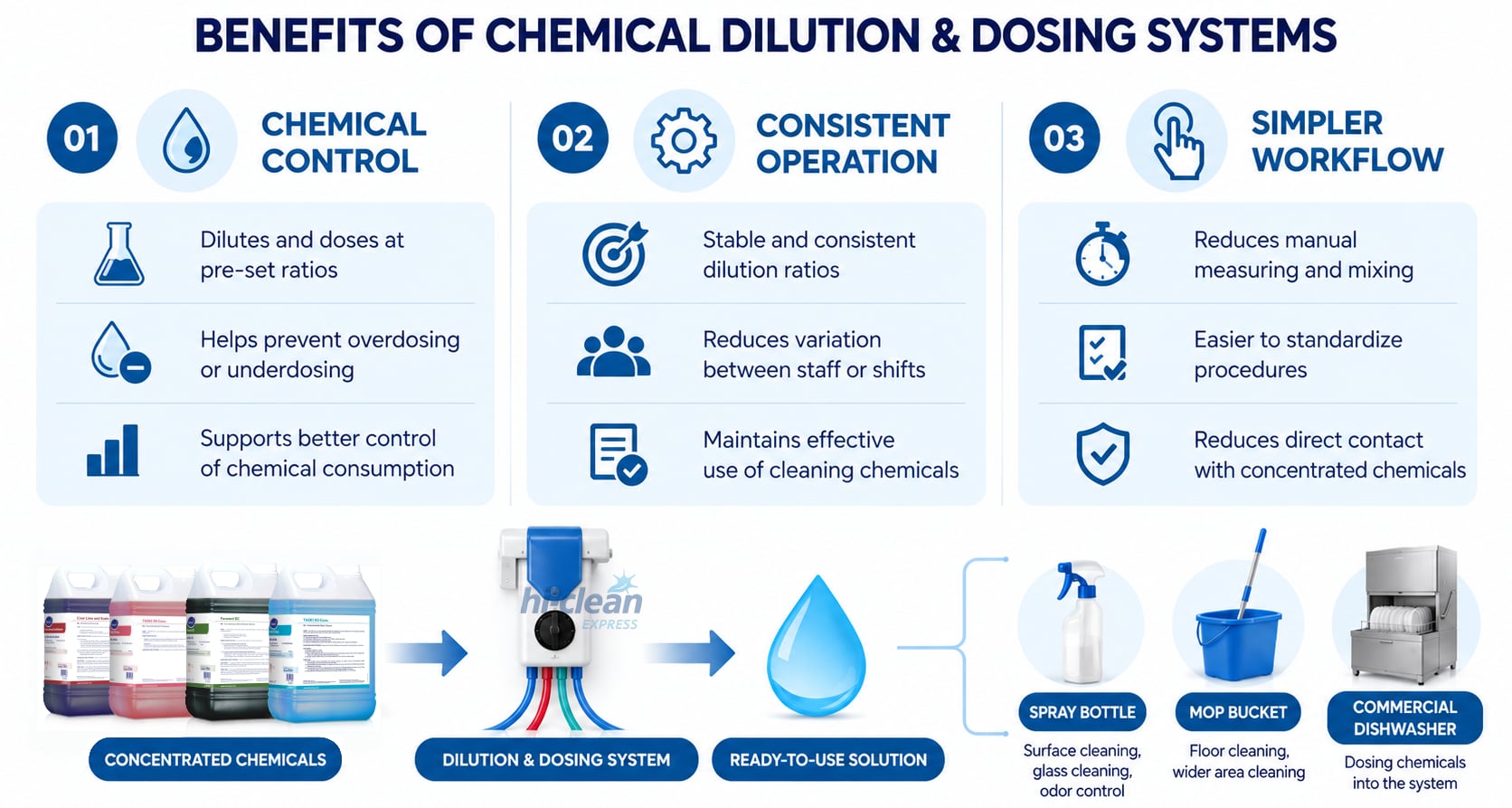
For commercial dishwashers, these benefits focus on controlling detergent and rinse aid usage, maintaining more consistent dosing, and reducing reliance on manual chemical dosing.
Are Dosing Systems Only for Large Commercial Kitchens?
No. If a business regularly operates a dishwasher with professional dishwashing chemicals, controlling chemical usage can be valuable whether it is an independent restaurant or a high-volume commercial kitchen operation.
The scale and frequency of use will affect the type of equipment that is suitable and the potential return on investment. When evaluating a dosing system, businesses should consider the overall picture, including chemical costs, labor, machine operation, and process control, rather than looking only at the purchase price of the equipment.
When Should a Business Consider Installing a Dosing System?
A business may consider an automatic dosing system when its dishwasher uses chemicals regularly, particularly when chemical consumption is difficult to monitor, employees are currently dosing chemicals manually, or the business wants to standardize procedures across work shifts.
The dosing equipment and dosage settings should be selected according to the dishwasher, chemicals, and actual operating conditions.
SEKO – Chemical Dosing Solutions for Commercial Kitchens
SEKO is a brand specializing in chemical dosing solutions, with experience dating back to 1976. In professional cleaning, SEKO develops a range of equipment for different chemical dosing and dilution requirements.
Hi-Clean Express currently offers two groups of SEKO solutions: WareDose for chemical dosing in commercial dishwashers and ProMini for diluting concentrated chemicals with water for professional cleaning applications.
This article focuses on the WareDose system. For applications that require concentrated chemicals to be diluted into ready-to-use solutions, businesses can also explore the SEKO ProMini 1 Product and SEKO ProMini 4 Products.
Two SEKO WareDose Options for Commercial Dishwashers
SEKO WareDose 30 LL
SEKO WareDose 30 LL uses two separate peristaltic pumps for detergent and rinse aid, with flow rates of 7 L/h for detergent and 1 L/h for rinse aid. Solution concentration can be controlled using a conductivity probe or timer.
SEKO WareDose 35
SEKO WareDose 35 is designed for high-intensity commercial dishwashing and glasswashing applications operating for more than 50 hours per week.
The unit features an adjustable flow range, microprocessor control, an LED display, and SEKO auto-calibration technology with a conductivity probe to support the detection and maintenance of solution concentration.
In general, WareDose 30 LL provides a dual-pump dosing configuration, while WareDose 35 offers more advanced adjustment and control capabilities for high-intensity applications.
Controlling Cost per Wash Cycle
For businesses, the important consideration is not only the total amount of chemical purchased each month, but also how much chemical is actually used per wash cycle and whether that usage remains consistent.
An automatic dosing system gives businesses better control over this recurring operating cost while reducing reliance on manually measuring and adding chemicals.
Hi-Clean Express provides integrated solutions for commercial kitchen operations, combining professional cleaning chemicals, dosing equipment, and solutions suited to the actual operating system.
Explore our SEKO chemical dosing and dilution equipment to learn more about the available solutions for businesses.


