

Ovens, grills and grill grates are among the kitchen equipment most prone to grease and food-residue buildup in restaurants, including establishments that serve tabletop grilled food. During high-temperature operation, grease and deposits can be repeatedly heated through multiple uses, creating stubborn buildup that is more difficult to remove than fresh or ordinary grease.
This is particularly common in BBQ, Grill & Hotpot restaurants and kitchens where grilling equipment is used frequently. If cleaning is only carried out after thick layers of grease and burnt-on residue have accumulated, the cleaning process can require significantly more time and effort.
For this reason, grilling equipment should be cleaned using a process appropriate for the type of equipment, level of soil, surface material and temperature at the time of cleaning.
Why Do Commercial Ovens and Grills Require a Specific Cleaning Method?
Grease and food residue on ovens, grills and grill grates are often repeatedly exposed to high temperatures, creating burnt-on grease and carbonised deposits that adhere firmly to the surface and are more difficult to remove than fresh grease. Over time, this buildup can become thicker and require more thorough cleaning.
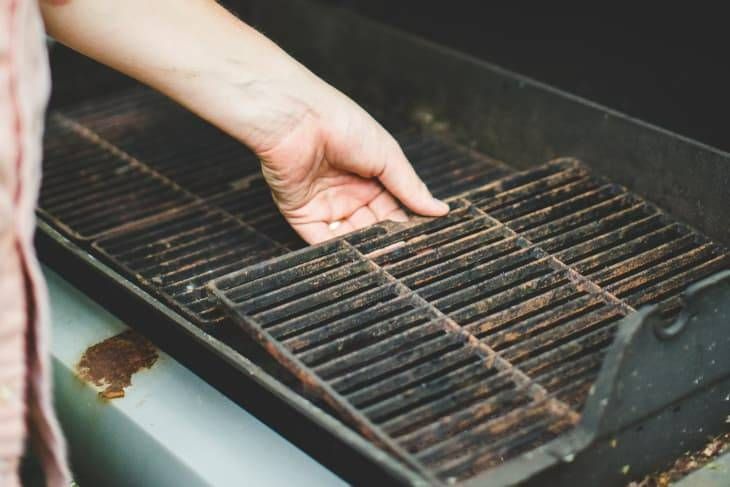
In addition to the level of soil, several factors should be considered before cleaning grilling equipment:
- The surface may still be hot after operation.
- Different cleaning chemicals may have different application temperature limits.
- Equipment may be made from stainless steel, aluminium, cast iron or other materials.
- Some components may come into direct contact with food.
- Equipment construction and cleaning instructions may vary between different types of equipment.
Therefore, although the basic cleaning steps may be similar, the conditions and method used for each step should be adjusted according to the equipment, material and cleaning chemical being used.
What Should Be Checked Before Cleaning Commercial Ovens and Grills?
The choice of oven and grill cleaning chemicals should be based on the type of equipment, level of grease, surface material and temperature at the time of cleaning. These factors should be identified before cleaning begins to avoid choosing an unsuitable method or chemical.
Identify the Equipment and Area to Be Cleaned
First, identify exactly which equipment or component needs to be cleaned, such as:
- Ovens
- Grills
- Grill grates
- Fryers
- Toasters
- Panini presses
Not every oven-cleaning product has the same range of applications across all of these types of equipment.
It is also important to distinguish between direct cooking surfaces and surrounding areas, such as exterior panels, areas underneath the equipment or components made from different materials.
Check the Surface Material
Identify the equipment material before using a cleaning chemical, particularly when working with aluminium, copper, cast iron and other soft metals.
Compatibility can vary between products. For example, a chemical that is suitable for stainless steel is not necessarily suitable for aluminium or cast iron.
If you are unsure about the material, check the equipment manufacturer's information before applying a chemical.
Check the Equipment Temperature
Do not automatically assume that all equipment must cool completely before cleaning. At the same time, chemicals should not be applied to hot surfaces unless the product is designed for those conditions.
The appropriate temperature depends on the chemical and cleaning procedure being used.
For example, when cleaning an oven or grill with SUMA GRILL, the recommended surface temperature is approximately 60–80°C, and the product should not be used on surfaces above 93.3°C.
By comparison, SUMA GRILL HI-TEMP CLEANER is designed for cleaning grills while the surface is still hot, at a minimum surface temperature of 100°C.
Equipment temperature is therefore part of the cleaning procedure, rather than simply a factor that makes grease easier to remove.
How to Clean Commercial Ovens and Grills
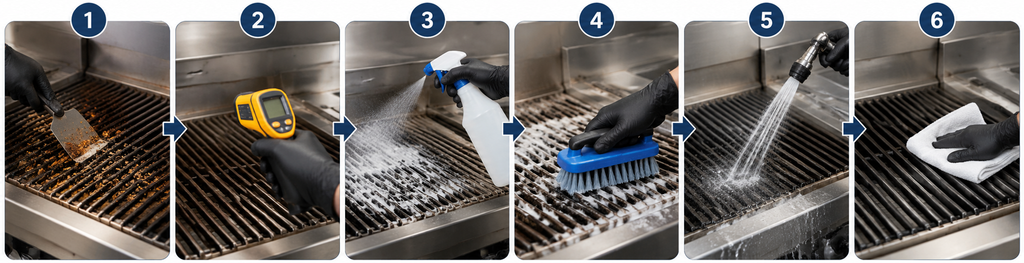
The exact procedure should follow the instructions provided by the equipment manufacturer and the cleaning chemical being used. However, a basic cleaning process for commercial grilling equipment generally follows the sequence below.
Step 1: Remove Food and Solid Debris
Before using water or chemicals, remove food particles, loose debris, excess grease and other solid soil that can be collected from the equipment.
For ovens, grills or grill grates with food residue and burnt-on deposits, an appropriate tool may be used to scrape or remove loose deposits where permitted by the equipment instructions.
Removing this debris first helps prevent it from spreading during cleaning and allows the chemical to make more direct contact with the remaining grease and deposits. This can reduce unnecessary chemical use and shorten the scrubbing and rinsing stages, making the cleaning process more efficient.
Step 2: Prepare the Equipment and Check the Temperature
After removing solid debris, bring the equipment or surface to the appropriate condition for the cleaning procedure being used.
Depending on the equipment and chemical, the equipment may need to be switched off and allowed to cool to a specified temperature, or cleaning may begin while the surface is still hot.
Before applying the chemical, confirm that the surface is within the appropriate temperature range for the product. Do not select a temperature based on judgement alone or substitute one chemical for another while keeping the same application conditions.
Step 3: Apply the Chemical According to Instructions
Use the amount or dilution ratio specified for the product.
Apply the chemical to the area being cleaned according to the recommended method and allow it to remain in contact with the grease, burnt-on grease or deposits for the specified contact time.
Do not increase the concentration in an attempt to clean faster. For difficult deposits, repeat the process if permitted by the product instructions rather than increasing the chemical amount beyond the specified range.
Step 4: Scrub and Remove Grease and Deposits
After the required contact time, remove loosened grease and deposits using a tool appropriate for the surface.
Depending on the equipment, a cloth, sponge or suitable scrubbing pad may be used. Avoid tools that could scratch or damage the equipment surface.
For long-term grease buildup or difficult burnt-on deposits, the cleaning process may need to be repeated according to the product instructions.
Step 5: Rinse or Wipe Away the Chemical
After removing grease and deposits, rinse or wipe the surface as specified in the product instructions.
For surfaces associated directly with food, it is particularly important to follow any requirement to rinse with clean water.
Do not leave chemical residue on surfaces where the procedure requires thorough rinsing.
Step 6: Dry and Inspect the Equipment
After cleaning, allow the equipment to air dry or complete the drying step specified in the instructions.
Inspect the cleaned areas to confirm that grease, deposits and cleaning chemicals have been properly removed before returning the equipment to operation.
Some equipment or cleaning procedures may include additional maintenance steps. For example, according to the SUMA GRILL instructions, after cleaning an oven or grill, the surface should be thoroughly rinsed with clean water, dried and then coated with cooking oil.
Important Conditions for Different Cleaning Chemicals
The basic cleaning steps may be similar, but surface temperature, dilution or application amount, contact time and material compatibility vary between products.
| Product | Typical Application | Temperature / Important Conditions | Key Usage Information |
|---|---|---|---|
| SUMA GRILL | Ovens, grills and fryers | Ovens/grills: 60–80°C; do not use on surfaces above 93.3°C | Can be used neat or diluted 1:10–1:20 for oven/grill cleaning; contact time 5–30 minutes. Do not use on aluminium, copper or cast iron. |
| SUMA EXTEND | Stovetops, ovens and other suitable equipment areas | For stovetop/oven cleaning: below 70°C | Contact time 10–30 minutes. Suitable for soft-metal surfaces such as aluminium and cast iron. |
| SUMA GRILL HI-TEMP CLEANER | Grills that need to be cleaned while the surface is still hot | Minimum surface temperature 100°C | Recommended application amount 60–100 mL; contact time 10–30 minutes. |
| SUMABRITE Oven Cleaner & Degreaser | Ovens and other suitable surfaces | Use according to product instructions | Ready-to-spray application; leave for 1–3 minutes and wipe clean. Rinse with water on food-contact surfaces. |
Note: The table above only summarises key information that distinguishes the application conditions of each product. Always check the individual product instructions and equipment manufacturer's guidance before incorporating a chemical into the cleaning procedure.
How to Clean Grill Grates in BBQ, Grill & Hotpot Restaurants
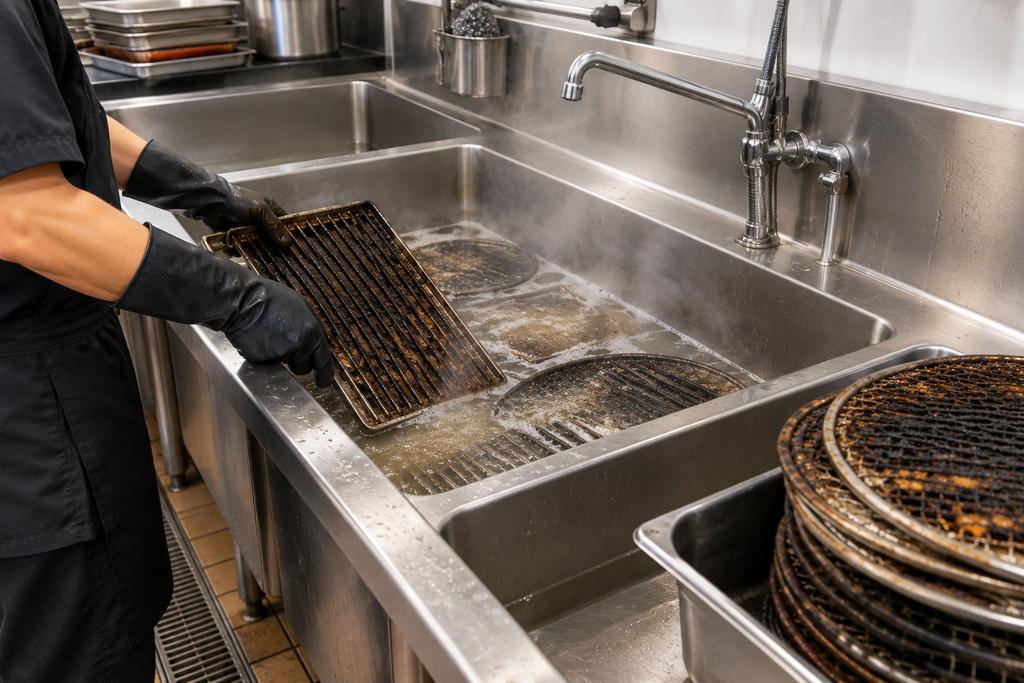
In BBQ, Grill & Hotpot restaurants that serve tabletop grilled food, cleaning grills and grill grates is a frequent task because grates may be replaced several times during service. Used grates are collected and transferred to the washing area, meaning that by the time they are cleaned, the surfaces may have cooled and grease and food residue may have adhered to them.
In this situation, the cleaning process can use a soaking method for removable grill grates rather than cleaning each grate immediately while it is still hot.
- Remove food and solid debris: collect food particles and remove loose or burnt-on residue from the grate before soaking.
- Prepare the soaking solution: dilute a suitable cleaning chemical with hot water according to the concentration and application conditions specified for the product.
- Soak the grill grates: place the grates in the solution and allow the chemical sufficient contact time with the grease and deposits.
- Scrub: after soaking, use an appropriate cleaning tool to remove the remaining grease and deposits from the surface.
- Rinse thoroughly: rinse thoroughly with clean water as required by the chemical instructions, particularly because grill grates are direct food-contact surfaces.
- Dry and inspect: inspect the surfaces before returning the clean grates to storage or reuse.
Using hot water together with an appropriate cleaning chemical during soaking can help remove grease from cooled grill grates and make the subsequent scrubbing process easier.
However, the same water temperature, chemical concentration or soaking time should not be applied to every type of grill grate. Check the grate material, chemical compatibility and product instructions before establishing a soaking procedure.
How Often Should Commercial Ovens and Grills Be Cleaned?
There is no single cleaning schedule suitable for every restaurant.
A BBQ grill operating continuously for many hours each day will accumulate grease at a different rate from an oven used only a few times per day. Similarly, in tabletop grilling restaurants, grill grates may be replaced and cleaned several times per day depending on the restaurant's operating procedures.
Rather than applying a fixed schedule, cleaning frequency should be based on equipment usage and its actual condition.
Checks at the beginning or end of a shift, or as part of a maintenance schedule, can be used to assess:
- The amount of fresh grease.
- Food residue on cooking surfaces.
- Burnt-on grease or carbonised deposits beginning to adhere firmly.
- Grease buildup around the equipment.
If deposits begin accumulating more quickly between cleaning cycles, the cleaning frequency may need to be adjusted rather than simply increasing the amount of chemical used.
Common Mistakes When Cleaning Commercial Ovens and Grills
Not Removing Food Debris Before Applying Chemicals
Applying chemicals while significant amounts of food and solid debris remain on the equipment increases the amount of soil that must be handled during the cleaning process.
Collect and mechanically remove as much removable debris as possible before cleaning the remaining grease and deposits.
Using the Same Chemical for Every Piece of Equipment
Ovens, grills, grill grates and other equipment may have different materials, construction and operating conditions.
A product that is suitable for one piece of equipment is not necessarily suitable for every piece of equipment in the kitchen.
Not Checking the Surface Material
This is particularly important for aluminium, copper, cast iron and other soft metals. Not every degreasing chemical is compatible with every material.
Using an incompatible chemical may affect the equipment surface, for example by causing discolouration, dulling, corrosion or damage to the surface finish. In some cases, the effect may not be immediately visible after the first cleaning but may become more apparent after repeated use of an unsuitable chemical.
Before use, identify the surface material and check compatibility according to the chemical instructions and equipment manufacturer's guidance. A chemical should not be selected solely for its degreasing performance without considering the material being cleaned.
Using Chemicals at the Wrong Temperature
Not every oven-cleaning chemical is designed for use on hot surfaces.
Conversely, some products are specifically designed for cleaning while the surface remains at a high temperature.
Always check the recommended temperature range for the product rather than selecting the cleaning temperature independently.
Increasing the Chemical Concentration or Amount
When deposits are difficult to remove, using more chemical should not be the default solution.
Use the recommended dilution ratio, application amount and contact time. Where necessary, repeat the procedure within the product's instructions.
Using an Unsuitable Scrubbing Tool
Scrubbing pads or tools that are too abrasive may affect certain equipment surfaces.
Select cleaning tools according to the surface material and equipment cleaning instructions.
Skipping the Rinsing Step
If the product requires rinsing with water, particularly on grill grates and other direct food-contact surfaces, this step should be completed thoroughly before the equipment is returned to use.
Skipping or inadequately completing the rinse can leave chemical and soil residues on the surface after cleaning. On food-contact surfaces, this may increase the possibility of residual chemical coming into contact with food when the equipment is used again.
Rinse thoroughly with clean water according to the product instructions, inspect the surface and complete any required drying or post-cleaning treatment before returning the equipment to operation.
Building the Right Cleaning Process for Commercial Grilling Equipment
Cleaning commercial ovens and grills involves more than removing visible grease from the surface. An appropriate process should consider the type of equipment, level of soil, surface material, temperature and chemical instructions.
The basic steps can be standardised, from removing solid debris and applying the cleaning chemical to scrubbing, rinsing and drying. However, specific parameters such as concentration, temperature and contact time should be determined according to the actual product and equipment.
For BBQ, Grill & Hotpot restaurants, the cleaning process should also reflect actual operations. When grill grates are replaced and collected during service, soaking them in hot water with a suitable cleaning chemical can be incorporated into the cleaning procedure rather than assuming that every grate must be cleaned while still hot.
If you have not yet determined which chemical is suitable for the grease condition or equipment being cleaned, see our guide to choosing professional degreasers for commercial kitchens and restaurants to compare different cleaning requirements and product applications.
For each product, review the application instructions and technical information on the product page before incorporating it into your restaurant's cleaning procedure.
If you need assistance selecting a product for your oven, grill, surface material or actual operating process, contact Hi-Clean Express for assistance.


